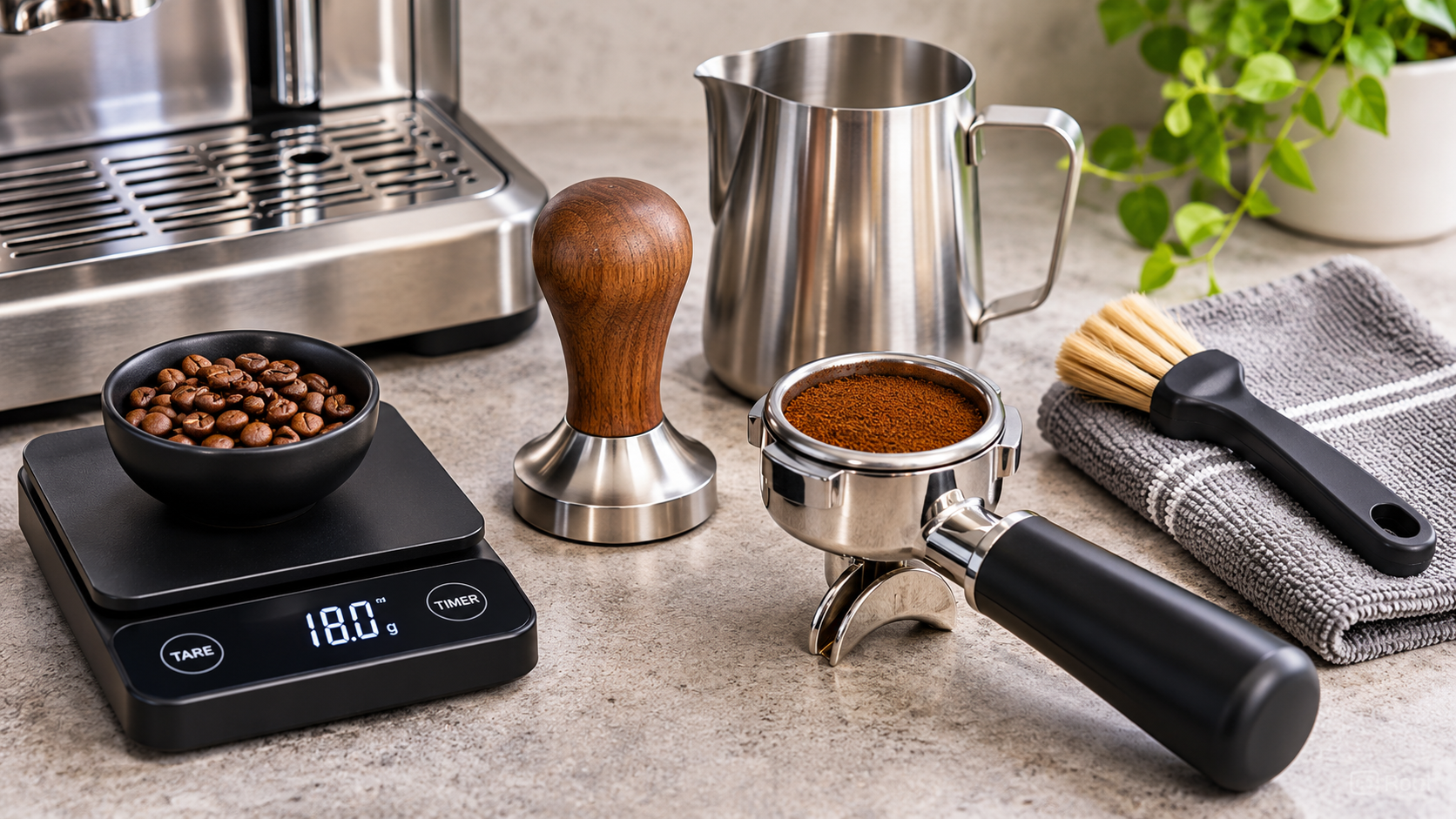
Espresso Accessories for Beginners: What You Actually Need
Starting a home espresso setup can feel surprisingly expensive. Once you have chosen a machine and grinder, you may encounter dozens of accessories promising better shots, easier preparation, and a more professional-looking coffee station.
But do you really need all of them?
For most beginners using a traditional espresso machine, a compact digital scale, a properly fitting tamper, and basic cleaning supplies are the most useful starting points. You may already have some of these items in the box. A milk pitcher matters if you make cappuccinos or lattes, while distribution tools and specialty baskets can usually wait.
This guide explains which espresso accessories deserve a place in your setup, what each one does, and how to avoid buying equipment you do not need.
Espresso Accessories: What Should You Buy First?
Before shopping, check the accessories supplied with your machine.
| Accessory | Priority | Why it matters |
|---|---|---|
| Digital espresso scale | High | Helps measure coffee dose and beverage yield consistently |
| Properly fitting tamper | High for manual tamping | Compresses coffee evenly in the basket |
| Cleaning cloth and suitable brush | High | Supports regular maintenance |
| Milk frothing pitcher | Conditional | Useful if your machine has a steam wand and you prepare milk drinks |
| Dosing funnel | Optional | Reduces spills while grinding into the basket |
| WDT distribution tool | Optional | Helps break up clumps before tamping |
| Knock box | Optional | Makes disposing of used coffee grounds easier |
| Bottomless portafilter | Later upgrade | Can help diagnose extraction problems |
| Puck screen | Later upgrade | Adds another step and cleaning requirement |
These priorities assume a machine with a conventional portafilter. Fully automatic machines and capsule systems have different accessory needs.
1. Digital Espresso Scale: The Most Useful First Purchase
A compact digital scale is one of the most practical espresso tools for a beginner.
It allows you to measure two important quantities:
- Dose: the weight of ground coffee going into the basket.
- Yield: the weight of brewed espresso in the cup.
For example, a recipe might use 18 grams of ground coffee to produce 36 grams of espresso. That is a 1:2 brew ratio, a useful starting point rather than a rule for every coffee.
Without a scale, it becomes harder to tell whether a different grind setting or dose actually improved your results.
What to look for
Choose a scale that:
- Measures in 0.1-gram increments.
- Fits beneath your machine’s portafilter and cup.
- Responds reasonably quickly as espresso flows.
- Has a clear display and an easy-to-use tare function.
A built-in timer is convenient, but it is not essential if you can time the shot separately.
Buying advice: A reliable, compact scale is generally a better early investment than decorative accessories or an expensive distribution system.
2. Espresso Tamper: Check the Fit Before Buying
A tamper compresses the ground coffee into a level puck before brewing.
For machines requiring manual tamping, it is an essential part of preparation. However, you may not need to purchase one separately.
Many espresso machines include a tamper, and some use assisted or automatic tamping systems.
Does tamper size matter?
Yes. The tamper must fit the filter basket correctly.
Some machines use nominal 54 mm systems, while others use 58 mm systems. Actual accessory dimensions can vary, so do not assume every tamper with the same advertised size will fit every basket perfectly.
Check the machine manual, the basket specifications, and the accessory manufacturer’s compatibility information.
Do beginners need an expensive tamper?
Usually not.
Start with the supplied tamper if it fits and works comfortably. Focus on keeping the coffee bed level and applying a consistent tamp.
A premium calibrated tamper may be convenient, but it is not a prerequisite for learning espresso.
3. Cleaning Tools: Small Purchases That Matter
Cleaning accessories may not be exciting, but regular maintenance helps keep your equipment working properly.
A basic cleaning kit can include:
- A clean, dedicated cloth for the machine and work area.
- A suitable group-head or coffee brush.
- A steam-wand cleaning cloth if your machine has a steam wand.
- Manufacturer-approved cleaning products when required.
Empty used coffee grounds promptly, clean the portafilter and basket according to the manual, and wipe the steam wand after use as instructed by the manufacturer.
Important: Backflushing, descaling, and detergent use are machine-specific. Do not assume every espresso machine supports the same cleaning procedure. Follow the manufacturer’s instructions, including product compatibility and maintenance intervals.
4. Milk Frothing Pitcher: Essential Only for Milk Drinks
If you regularly prepare cappuccinos, lattes, or flat whites with a steam wand, a stainless steel milk pitcher is useful.
A pitcher gives you room to texture milk and helps you control pouring.
Beginners should look for:
- A size appropriate for the amount of milk they usually prepare.
- A comfortable handle.
- A defined pouring spout.
- Durable, easy-to-clean construction.
A small pitcher is often sufficient for one drink, but the right size depends on your machine and serving preferences.
If you only drink straight espresso or Americanos, you can skip this accessory.
Also check the box: some espresso machines already include a milk pitcher.
5. Dosing Funnel: A Simple Way to Reduce Mess
A dosing funnel sits on top of the portafilter basket while coffee is transferred or ground into it.
Its main purpose is simple: keep more coffee inside the basket and less on the counter.
This can be especially helpful when using a grinder that produces a fluffy mound of grounds.
Before purchasing, check:
- Basket and portafilter compatibility.
- Whether the funnel attaches securely.
- Whether it interferes with your grinder’s portafilter holder.
- Whether it must be removed before tamping.
A dosing funnel is convenient, not essential. If your current workflow is clean and consistent, there is no urgent reason to buy one.
6. WDT Tool: Useful, but Not a Requirement
WDT stands for Weiss Distribution Technique.
A WDT tool uses thin needles to gently distribute coffee grounds and break up clumps before tamping.
It can help when grounds collect unevenly in the basket, especially with some grinders.
However, not every beginner needs one immediately.
Start by learning to measure your dose, adjust your grind, distribute grounds reasonably evenly, and tamp consistently. If clumping or uneven extraction remains a recurring problem, a simple WDT tool may be worth trying.
Use it carefully to avoid damaging the basket or injuring yourself with the needles.
7. Knock Box: Convenience Rather Than Necessity
A knock box provides a dedicated place to discard used espresso pucks.
It can make cleanup faster, especially when preparing several drinks.
But a beginner who makes one or two drinks a day can often manage without one.
If you decide to buy a knock box, consider:
- Stability on the counter.
- Available kitchen space.
- Ease of cleaning.
- Noise and durability.
Avoid buying a large commercial-style knock box unless your routine genuinely calls for it.
Espresso Accessories You Can Skip at First
Some products become useful as your skills develop. Others may never be necessary for your setup.
Bottomless portafilter
A bottomless portafilter exposes the underside of the basket and can make certain extraction problems easier to observe.
It is not automatically an upgrade in espresso quality, and it may spray coffee if preparation is uneven.
Compatibility is critical: matching the nominal basket diameter is not enough. The portafilter must also fit the machine’s group head and locking mechanism.
Precision filter baskets
A different filter basket can change how coffee flows through the puck.
However, a new basket may also require changes to grind size and dose. Beginners should learn their existing equipment before replacing components that already work adequately.
Puck screens
A puck screen sits above the coffee bed during extraction.
It may help keep some coffee residue away from the shower screen, depending on the machine and workflow, but it introduces an additional item to clean and may affect headspace.
It is not necessary for making good espresso.
Premium distribution systems
Expensive leveling devices and elaborate preparation stations can make a setup look professional.
That does not mean they offer the best value for a beginner.
Put your budget toward reliable brewing equipment, a suitable grinder, fresh coffee, and repeatable preparation first.
How to Choose Accessories That Fit Your Espresso Machine
Before buying any espresso accessory, follow this checklist:
- Identify your exact machine model. Brand names alone are not enough.
- Check what is included. You may already own a tamper, pitcher, baskets, or cleaning tools.
- Confirm compatibility. Pay special attention to tampers, baskets, funnels, portafilters, and cleaning products.
- Consider your actual drinks. Milk-drink accessories are less important if you only prepare espresso.
- Solve a specific problem. Buy an accessory because it improves your routine, not because it appears in a popular setup photo.
If you are still choosing a machine, read our guide to the best espresso machines for beginners.
You can also explore our budget espresso grinder comparison to understand why grinder choice matters more than accumulating optional accessories.
A Practical Beginner Espresso Setup
A sensible starting setup might contain:
For straight espresso:
- A suitable espresso machine.
- An espresso-capable grinder, unless the machine has an appropriate built-in grinder or you use a compatible pre-ground coffee workflow.
- Fresh coffee.
- A compact digital scale.
- A compatible tamper if manual tamping is required and one is not supplied.
- Basic cleaning supplies.
For milk-based drinks: add a milk pitcher if your machine has a steam wand and one is not already included.
After using this setup for a few weeks, you will have a clearer idea of whether a dosing funnel, WDT tool, or knock box would make your routine easier.
The goal is not to own every espresso tool. It is to make repeatable coffee with equipment you understand.
Frequently Asked Questions
What are the most important espresso accessories for beginners?
For a traditional manual espresso setup, start with a compact digital scale, a compatible tamper, and basic cleaning supplies. Some machines include the tamper and cleaning accessories, so check before purchasing anything.
Do I need a WDT tool to make good espresso?
No. A WDT tool can help distribute clumpy coffee grounds, but beginners can make good espresso without one. Consistent dosing, suitable grinding, and good basic preparation are more important starting points.
Do all espresso machines use 58 mm accessories?
No. Portafilter and basket sizes vary by manufacturer and model. Even accessories marketed for the same nominal diameter may differ in fit. Always verify compatibility.
Is a bottomless portafilter worth buying as a beginner?
It can be useful for observing extraction behavior, but it is not essential. Learn your machine and existing portafilter before considering one.
Should I buy an espresso accessory kit?
Only if the included items fit your machine and you actually need most of them. A kit is not automatically better value than purchasing one or two useful accessories separately.
Do I need an espresso scale with a timer?
A timer is convenient, but a compact scale that measures accurately and responds quickly is the more important requirement. You can use a separate timer if needed.
Final Verdict: Buy Less, Learn More
The best espresso accessories for beginners are the ones that make brewing easier to measure, repeat, and maintain.
Start with a scale, an appropriate tamper, and cleaning essentials. Add a milk pitcher if you prepare milk drinks. Consider a dosing funnel or WDT tool when you identify a genuine need.
Leave expensive upgrades until you understand what your current equipment can do.
A thoughtful home espresso setup is built around good fundamentals—not the number of accessories on your counter.
Editorial disclosure: This guide is based on manufacturer documentation, equipment specifications, and published educational resources. Espresso Setup Guide does not claim to have physically tested the accessories discussed here. Product compatibility and maintenance requirements should always be verified with the manufacturer.
Manufacturer Resources and Further Reading
Before purchasing espresso accessories, check your machine’s specifications and maintenance instructions.
- Breville — Bambino Plus Support & Documentation— examples of included accessories and manufacturer maintenance guidance.
- Breville — How to Clean an Espresso Machine — cleaning and maintenance guidance for compatible machines.
Always follow the instructions for your specific machine model.